
Pyramid Model Program-Wide Implementation Coaching
Bring out the best in your program.
Give your team the tools they need to succeed. We coach early childhood professionals to create safe and welcoming spaces, help kids handle big emotions, and confidently guide them through behaviors that are challenging.
The framework is best put in place before mental health professionals are needed.
Jump to Section Below About the Pyramid Model
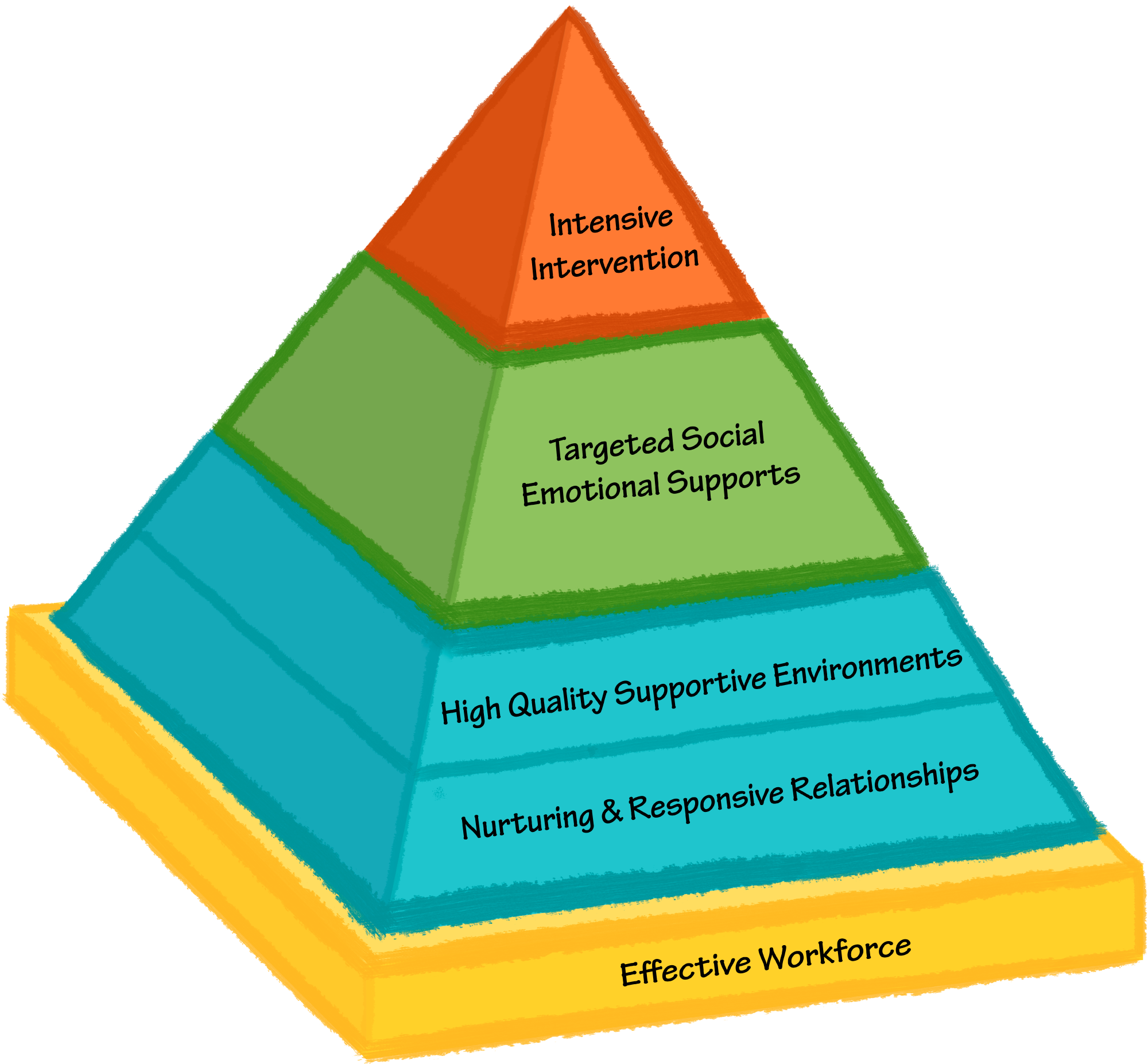
Tier 3 · Intervention
INTENSIVE · FOR THE FEW
Intensive, individualized, team-based support.
3-5% need individualized plans.
For the small number of children whose needs require a coordinated, data-based, and responsive intervention.
Covered in Module 3 training
Tier 2 · Prevention
TARGETED · FOR THOSE WHO NEED MORE
Targeted socio-emotional skill-building.
~15% benefit from added support.
Intentional teaching of friendship skills, emotional vocabulary, and emotional regulation benefits all children while targeting the individual needs of the roughly 15% who require additional support.
Covered in Module 2 training
Tier 1 · Promotion
UNIVERSAL - FOR EVERY CHILD
Nurturing and responsive relationships + high-quality environments.
~80% of children's needs met here.
Warm, responsive relationships and well-designed classrooms meet the social-emotional needs of about 80% of children.
Covered in Module 1 training
Base · Effective Workforce
THE BASE
A skilled, supported workforce holds everything above it up.
When educators and staff have training, coaching, and leadership behind them, every tier above becomes possible. This is where it all starts.
~95%
of children's social-emotional needs are met when Tiers 1 and 2 are implemented with fidelity, no individual intervention required.
HOW IT WORKS
What working together looks like
A program-wide partnership, not a one-off training. Four steps, from first hello to a change that lasts.
1
We Partner With Your Program
You're matched with a coach from the Center for Autism and Early Childhood Mental Health (CAECMH) who brings the training, tools, and data support for your whole team. Coaching and training are free for qualifying private childcare sites; Head Start and Department of Education (DOE) programs pay for services.
2
We Build Your Team's Skills
Staff learn the framework, and coaches work alongside teachers in real classrooms. Practice, not just theory.
3
We Track What's Working
Your leadership team reviews simple data each month and adjusts, so progress is something you can actually see.
4
You Carry It Forward
An internal coach on your staff takes the reins, so the change sticks long after the partnership ends.
The 3–5 year roadmap to fidelity
Four stages, at your program's pace, from first hello to becoming a model for others.
STAGE 1 ↦
Exploration
- Attend an info session
- Share with full staff
- Run a staff buy-in survey
- Submit Program Leadership Team (PLT) roster + application
STAGE 2 ↦
Installation
- Module 1 training (12 hrs)
- PLT leadership training (6 hrs)
- Behavior Incident Report System (BIRS) overview for all staff (2 hrs)
- Baseline data collected
- Coaching schedule set
STAGE 3 ↦
Implementation
- Bi-weekly classroom coaching
- Monthly PLT meetings
- Modules 2 & 3 (years 2–3)
- Internal coach training & mentoring begins
- Data reviewed monthly
STAGE 4 ↦ ★
Full Implementation
- Internal coach takes over
- All classrooms at fidelity
- Sustainability plan in place
- CAECMH fidelity checks
★ Advancing to Demonstration Site Status
MYTH VS. REALITY
Let's Clear a Few Things Up
Tap a card to flip it - what people assume, and what's actually true.
THE MYTH
'It's a quick fix.'tap to see the reality →
THE REALITY
It's a 3-5 year journey that builds lasting program-wide change.THE MYTH
'It's child-directed.'tap to see the reality →
THE REALITY
It's adult-directed. It builds the skills of the grown-ups around the child.THE MYTH
'It's just for teachers.'tap to see the reality →
THE REALITY
It's for everyone who touches a child's day; admins, aides, families, support staff.THE MYTH
'It's a mental health treatment.'tap to see the reality →
THE REALITY
It's promotion and prevention, best in place BEFORE mental health intervention is needed.THE MYTH
'If a child needs something different, that's a top-of-the-pyramid piece of work.'tap to see the reality →
THE REALITY
Individualized supports are part of developmentally appropriate practice and can be found at all tiers of the Pyramid.OUTCOMES
What Implementing Programs Report
Outcomes identified by teachers, administrators, and coaches using the Pyramid Model. Measured, not promised.
91%
Report improved children's social-emotional outcomes
92%
Report increased staff skills supporting development
82%
Report reductions in challenging behavior
78%
Report fewer children removed from the classroom
Source: National Center for Pyramid Model Innovations (NCPMI), Pyramid Model Implementation: A Snapshot of Outcomes. These figures come from a national survey of programs across nine states engaged in statewide implementation. They are not New Jersey state data. See challengingbehavior.org.
The Pyramid Model, growing across New Jersey
Demonstration sites in Passaic and Camden counties, a third installing in Bergen County, and active implementation sites across ten counties, with more installing this year. Tap a county on the map to see the programs working there.
Select a county
Tap any county on the map to see its current sites.
IN ACTION
Step Inside an Implementation Site
Real programs, real classrooms. A look at what the framework looks like day to day, in the words of the people doing the work.
Coming October 2026!
FEATURED SITE information is currently being updated in October 2026
BECOME A SITE
What Becoming a Site Involves
Clear eyes going in. Here's the commitment, and we walk beside you through every piece of it. (Coaching happens only within designated implementation classrooms.)
3-5 YEARS
A Real Journey
Program-wide implementation, with support from the Center for Autism and Early Childhood Mental Health (CAECMH) from first session to fidelity.
ABOUT 30 HOURS
Everyone Trains
Training over 3 years for all staff, including non-instructional team members.
EVERY 2 WEEKS
On-Site Coaching
45–60 minutes of paid, protected time per teacher for practice-based coaching.
MONTHLY
Leadership Team
Your Program Leadership Team (PLT) meets one hour a month: admin, teachers, a family member, and your coach.
YEARS 2-3
Your Own Coach
An internal coach is prepared through a 3-year seminar (about 18 hours per year) to sustain the work after the external coach exits.
ONGOING
Data That Guides
Classroom observations twice a year with the Teaching Pyramid Observation Tool (TPOT) and Teaching Pyramid Infant-Toddler Observation Scale (TPITOS), weekly reporting through the Behavior Incident Report System (BIRS), and program Benchmarks of Quality (BOQ).
VOICES FROM THE FIELD
What Changes When a Whole Program Commits
Stories from the people doing the work.
[TESTIMONIAL — a director on culture change across the whole program]
[Name, Role] · [Site]
Being updated in October 2026
[TESTIMONIAL — a director on culture change across the whole program]
[Name, Role] · [Site]
Being updated in October 2026
Frequently Asked Questions
Is the Pyramid Model a curriculum?
No. It wraps around whatever curriculum you use, building the adult practices and program systems that help all children succeed.
Who needs to be involved?
The whole program: administrators, lead and assistant teachers, support staff, and family representatives. It's not only for classroom teachers.
How long does it take?
A 3–5 year journey through four stages, ending in eligibility for Demonstration Site status.
Where does coaching happen?
Practice-based coaching occurs only within designated Pyramid Model implementation classrooms.
How do we start?
Attend an information session. It's no-commitment and answers your questions before you decide to apply.
WHY THIS WORK MATTERS
Children build social-emotional skills through everyday relationships and experiences.
The relationships you nurtute
The environments you create
The skills you teach
Researchers call this Early Relational Health (ERH) - and it’s everyone’s business. Those moments come easier when the whole program, every teacher, aide, and administrator, is trained, coached, and supported together. That is exactly what the Pyramid Model builds. Learn more →
TAKE THE FIRST STEP
Curious? Start with a conversation.
An information session is the easiest way in. No commitment, every question answered. Applications for new Implementation Sites open seasonally.
Questions? Call 973-655-6685 · email njpyramid@montclair.edu